What CEOs Should Review During a Workation
Many business owners take vacations.
Successful CEOs take workations.
The difference is simple.
A vacation is designed to help you disconnect.
A workation is designed to help you reconnect—with your vision, your goals, and the future of your business.
When you step away from daily operations, you gain something most business owners struggle to find:
Perspective.
A workation creates space to think strategically instead of constantly reacting to emails, meetings, and daily demands.
The question is not whether you should review your business during a workation.
The question is what you should review.
Direct Answer
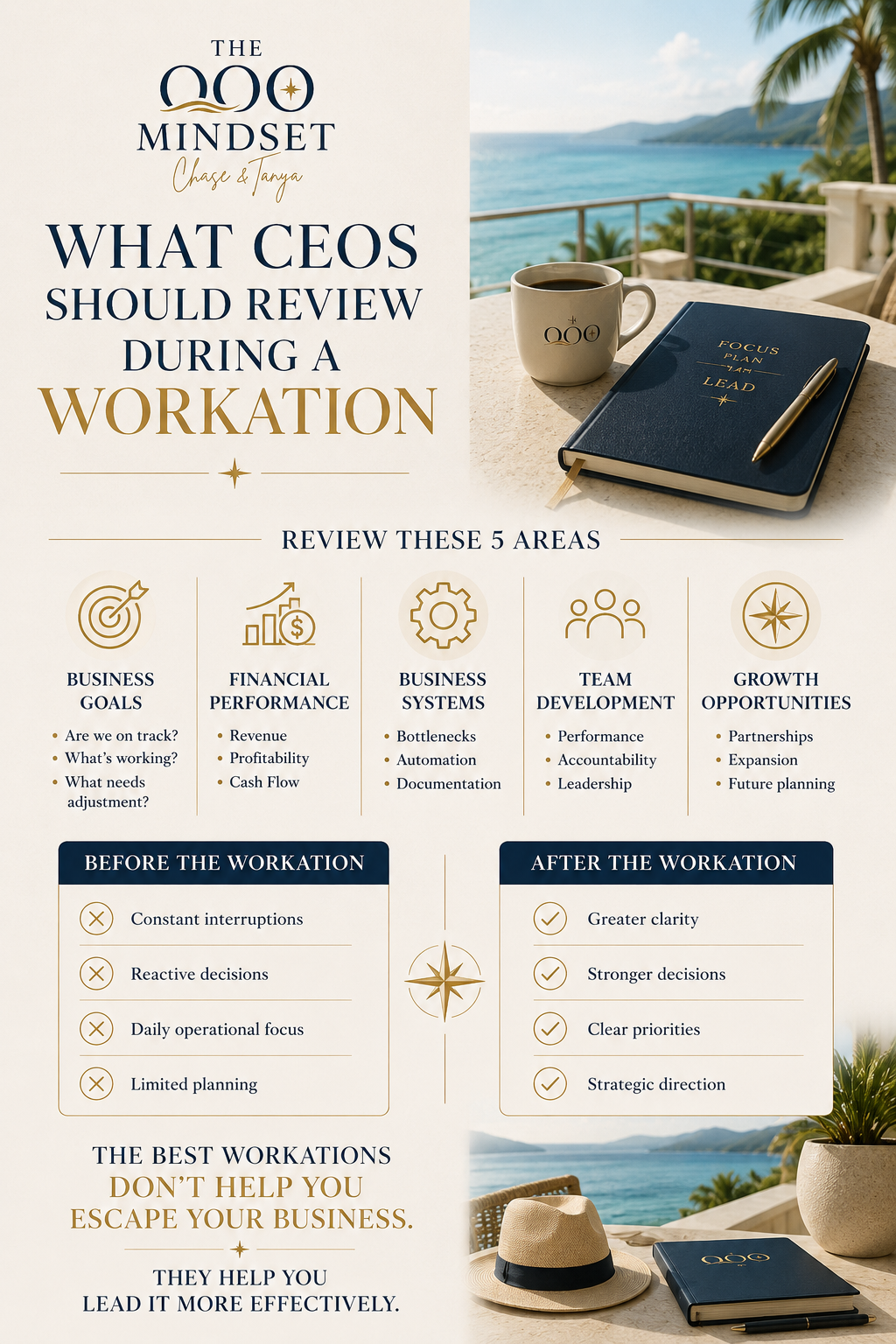
A workation provides the perfect opportunity for CEOs to review business goals, financial performance, systems, team development, and future growth plans. Strategic reviews help leaders return with clarity, direction, and a stronger plan for the next phase of growth.
1. Review Your Business Goals
When was the last time you looked at your goals without distractions?
Many business owners create goals at the beginning of the year and never revisit them.
During your workation, ask yourself:
Are we on track?
What goals have been achieved?
What needs adjustment?
Are our priorities still aligned with our vision?
Growth requires regular evaluation.
Without review, it is easy to drift away from what matters most.
2. Review Your Financial Performance
Your numbers tell the real story of your business.
A workation is the perfect time to review:
Revenue trends
Profitability
Cash flow
Major expenses
Financial goals
Many business owners spend more time reviewing social media analytics than financial reports.
Successful CEOs know that financial clarity drives better decisions.
The stronger your understanding of the numbers, the stronger your future decisions become.
3. Review Your Systems
One of the biggest signs of growth is complexity.
As businesses grow, systems become more important.
Ask yourself:
What processes are working?
Where are bottlenecks occurring?
What tasks still depend on me?
What can be automated?
What needs documentation?
A workation provides time to evaluate operations instead of simply operating.
4. Review Your Team
Great businesses are built by great people.
During your workation, evaluate:
Team performance
Leadership development
Accountability
Communication
Future hiring needs
Strong teams create freedom for business owners.
Weak teams create dependency.
Your review should focus on building a business that can continue operating effectively without constant oversight.
5. Review Your Future Growth Plan
Many CEOs become so focused on current operations that they stop planning for future growth.
A workation creates space to think bigger.
Consider:
New opportunities
Strategic partnerships
Market expansion
Service development
Long-term goals
The purpose of a workation is not simply to escape your business.
It is to gain clarity about where it is going next.
Reactive CEO vs Strategic CEO
Reactive CEO
Focuses on daily problems
Constant interruptions
Limited planning
Operates in survival mode
Growth feels stressful
Strategic CEO
Reviews goals regularly
Understands financial performance
Evaluates systems
Develops future plans
Leads with clarity
Reality Check
Most business owners do not need more information.
They need more time to think about the information they already have.
A workation provides something many CEOs rarely experience:
The ability to step back and evaluate the business from a higher level.
That perspective often creates breakthroughs that never happen in the middle of a busy workweek.
Final Thoughts
Your business grows based on the quality of your decisions.
The quality of your decisions depends on the clarity you have as a leader.
A workation creates the space needed to review your goals, finances, systems, team, and future growth opportunities.
The goal is not simply to get away.
The goal is to return with greater clarity than when you left.
