Why Entrepreneurs Should Analyze Cruise Operations
A cruise ship can feel like the ultimate escape from business.
You board the ship, unpack once, and suddenly everything seems to happen around you.
Meals are prepared.
Rooms are cleaned.
Entertainment runs on schedule.
Thousands of guests move through the same spaces every day.
And somehow, the entire operation keeps moving—even while the person at the top isn't personally managing every interaction.
For entrepreneurs, there's a business lesson hidden in that experience.
A cruise isn't just a vacation.
It's an opportunity to observe what happens when strong systems, clear roles, and repeatable processes work together.
The Direct Answer
Entrepreneurs should analyze cruise operations because cruise ships demonstrate many of the systems required to run a scalable business.
From delegation and customer experience to standard operating procedures and operational efficiency, cruise lines provide real-world examples of how large organizations deliver consistent experiences without requiring one person to manage every detail.
The goal isn't to turn your business into a cruise line.
It's to notice what successful operations can teach you about building a business that functions without your constant involvement.
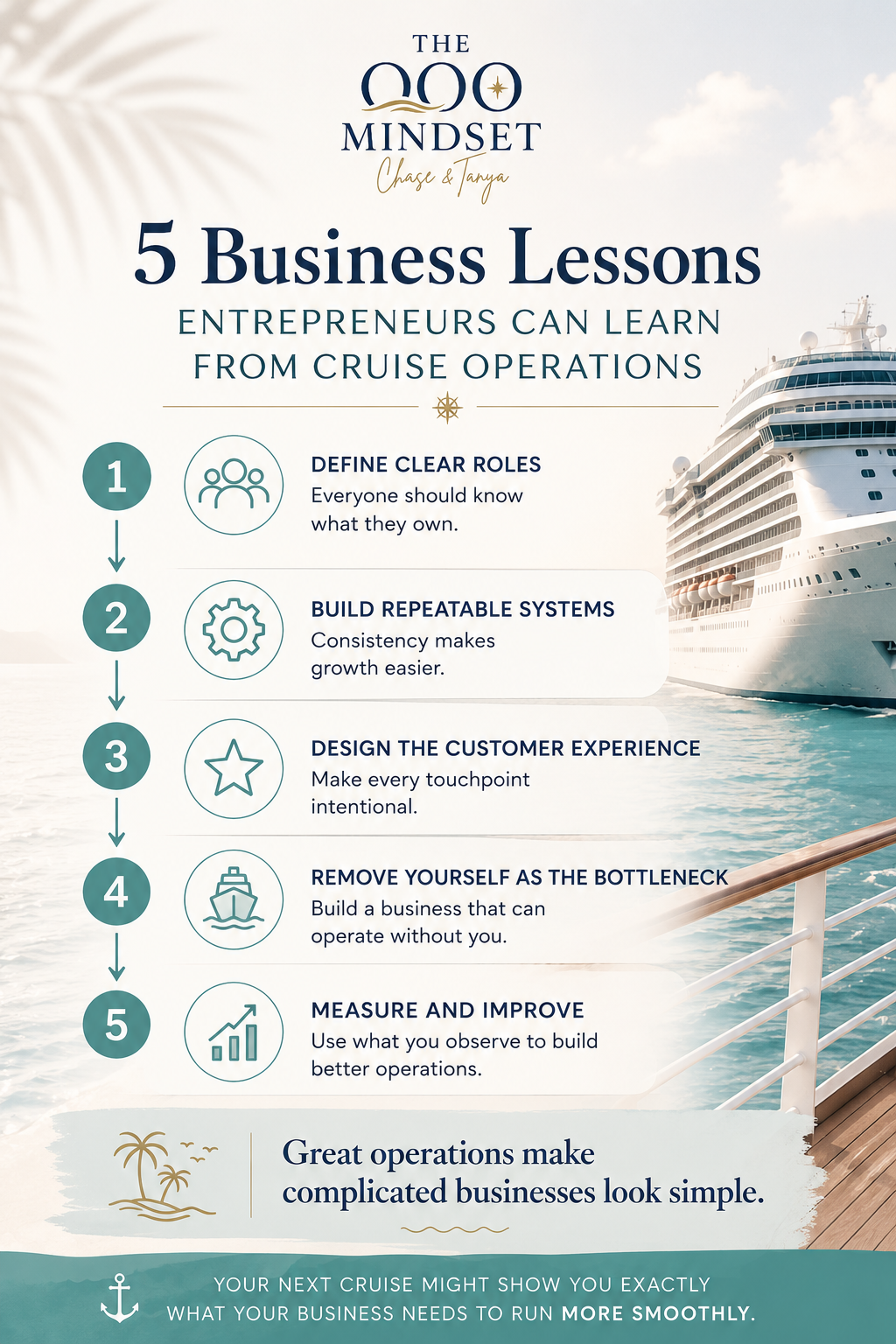
1. Every Person Has a Clear Role
On a cruise ship, everyone has a job.
The housekeeping team isn't running the restaurants.
The entertainment team isn't managing the engine room.
The captain isn't checking guests into their cabins.
Each person understands their responsibilities and how their role contributes to the overall operation.
Business owners can learn from this.
As your company grows, responsibilities need to become clearer.
Ask yourself:
Does everyone on my team know what they own?
Are responsibilities clearly defined?
Do employees know who makes which decisions?
Am I still doing work someone else should own?
When roles aren't clear, everything eventually comes back to the business owner.
Clear ownership creates accountability—and gives the CEO room to lead.
2. Systems Create Consistency
Cruise ships serve thousands of guests every week.
They can't reinvent their processes for every new sailing.
Instead, they rely on repeatable systems.
There are processes for:
Boarding guests
Preparing rooms
Serving meals
Managing activities
Handling emergencies
Turning the ship around for the next sailing
The same principle applies to business.
If your team has to ask you how to complete the same task every time, you don't have a scalable system yet.
Documented processes help your business deliver consistent results without depending on one person's memory.
3. The Customer Experience Is Intentional
Think about how many touchpoints exist during a cruise.
Booking.
Check-in.
Your cabin.
Dining.
Entertainment.
Excursions.
Customer service.
Each interaction contributes to the guest's overall experience.
Entrepreneurs can apply the same thinking to their businesses.
Map your customer's journey from the moment they discover your company until long after they make a purchase.
Where are customers confused?
Where do they have to wait?
Where could communication improve?
What moments make them want to return?
Great customer experiences rarely happen accidentally.
They're designed.
4. The Operation Continues Without the CEO
One of the biggest lessons entrepreneurs can learn from cruise operations is that the organization doesn't depend on one person to function.
The CEO of the cruise line isn't personally approving every meal, answering every customer question, or managing every employee schedule.
Leadership establishes the strategy.
Systems and teams execute it.
Many entrepreneurs struggle to create this separation.
They become the person everyone needs before anything can move forward.
A scalable business requires something different.
The goal is to build an organization where the business owner provides direction without becoming the bottleneck.
5. Small Details Are Measured and Improved
Cruise operations involve enormous amounts of data.
Companies need to understand customer preferences, staffing needs, inventory, spending patterns, capacity, scheduling, and countless other operational details.
Business owners should develop the same habit of observation.
Ask:
Where are we losing time?
Where are we losing money?
What do customers repeatedly request?
Which processes create frustration?
What could we automate?
What should we stop doing?
You don't need thousands of employees to think operationally.
You simply need to pay attention to what your business is telling you.
Running the Business vs. Building the Operation
Running the Business
Solving every problem yourself
Answering every team question
Keeping processes in your head
Reacting to problems as they happen
Being involved in every decision
Building the Operation
Creating clear roles
Documenting repeatable processes
Delegating decision-making
Measuring performance
Improving systems continuously
One keeps you busy.
The other creates a business that can grow beyond you.
Reality Check
A cruise ship isn't a perfect comparison for every business.
Cruise lines operate at a completely different scale and have complex systems built over many years.
But that's exactly why they're interesting to observe.
When you're away from your normal environment, you have an opportunity to look at business differently.
Instead of simply asking, "Am I enjoying this experience?"
Try asking:
"What had to happen behind the scenes to make this experience possible?"
That question can completely change the way you see your own company.
Your Next Cruise Could Be a Business Lesson
You don't have to spend your entire vacation thinking about work.
But intentional travel can create space to observe, think, and return to your business with a different perspective.
That's part of what Out of Office On Purpose is about.
Stepping away doesn't always mean disconnecting completely. Sometimes it means creating enough distance from your daily routine to finally see your business clearly.
The next time you're on a cruise, pay attention.
Notice the systems.
Watch how teams communicate.
Study the customer experience.
Look for processes that happen seamlessly without you ever seeing the work behind them.
Then ask yourself:
What would my business look like if it could operate with that same level of clarity?
Because sometimes the best business ideas happen when you're finally out of the office.
