The Hidden Cost of Being Reachable
One of the benefits of running your own business is freedom.
The freedom to build your schedule. The freedom to work from different places. The freedom to create a business that supports the life you want.
But somewhere along the way, many entrepreneurs trade that freedom for constant availability.
Your phone is always nearby.
Emails follow you to dinner.
Slack messages interrupt your vacation.
Clients know they can reach you at almost any time.
Even when you are technically out of the office, part of you is still working.
Being reachable may feel responsible.
But constantly being available has a cost—and your business may be paying for it too.
The Problem: Being Available Is Not the Same as Being Effective
Entrepreneurs often become the default person for everything.
A client has a question? They call you.
An employee needs a decision? They message you.
Something unexpected happens? You fix it.
In the beginning, this may be necessary.
But as the business grows, constant availability can become a habit.
You start responding immediately because it feels faster than creating a system.
You make every decision because it feels easier than delegating.
You stay connected while traveling because you are worried something might happen without you.
Eventually, your business becomes dependent on your availability.
And instead of owning a business that gives you freedom, you have created a business that requires you to always be within reach.
The Direct Answer: Constant Availability Creates Hidden Costs
The cost of being reachable is not always obvious.
You may not see it on your profit and loss statement.
But it can show up in other ways.
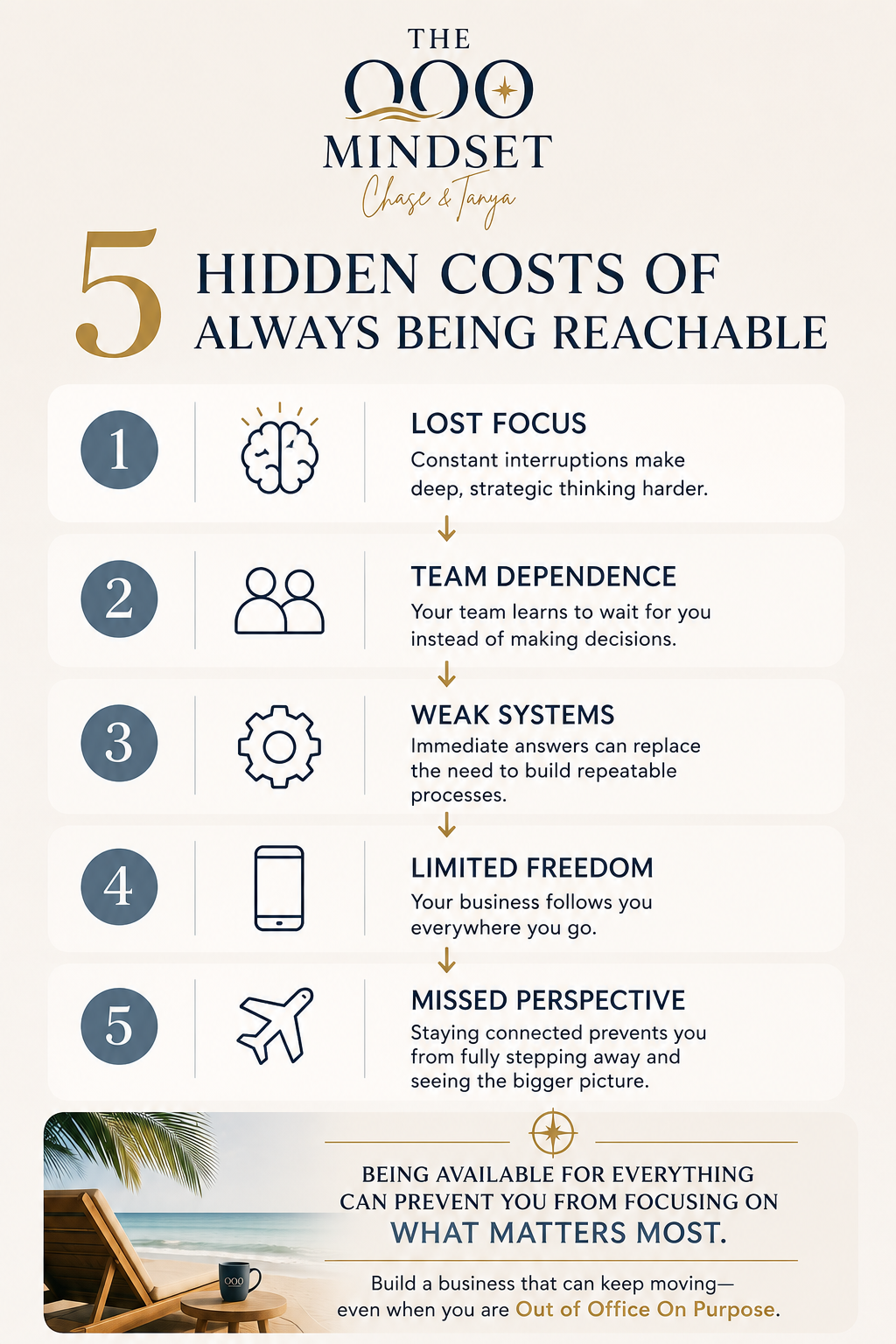
You lose uninterrupted thinking time.
Your team waits for you instead of making decisions.
Clients expect immediate access.
You struggle to fully disconnect.
And important strategic work gets pushed aside because urgent requests always come first.
Over time, constant availability can prevent you from doing the work that only you, as the CEO, can do.
The goal is not to become unavailable.
The goal is to stop being unnecessarily available.
How to Become Less Reachable Without Losing Control
Step 1: Define What Actually Requires You
Not every question needs the CEO.
Look at the requests that regularly interrupt your day.
Which ones truly require your expertise or authority?
Which could be handled by someone else?
Separating CEO-level decisions from everyday questions is the first step toward creating space.
Step 2: Create Clear Communication Boundaries
Your clients and team need to know when and how to reach you.
Establish expectations around response times, communication channels, and emergencies.
When everything is treated as urgent, nothing is truly urgent.
Step 3: Build Systems for Repeated Questions
If you answer the same question repeatedly, you may not have a communication problem.
You may have a systems problem.
Document processes.
Create templates.
Build checklists.
Give your team clear guidelines for common situations.
Every system you create reduces the number of decisions that have to come back to you.
Step 4: Give Your Team Permission to Decide
Delegation is not simply assigning tasks.
It is giving people the authority to make appropriate decisions.
If your team still needs your approval for every small detail, you may have delegated the work without delegating the responsibility.
Clear decision-making guidelines can help your team move forward without waiting for you.
Step 5: Test Your Business by Stepping Away
You do not have to disappear for a month.
Start small.
Take an afternoon without checking your email.
Then try a full day.
Eventually, take a trip where you intentionally limit your availability.
Pay attention to what happens.
Every interruption can reveal a system, process, or responsibility that needs improvement.
Always Reachable vs. Intentionally Available
Always Reachable:
Responds to every message immediately.
Checks email throughout the day and while traveling.
Makes most decisions personally.
Becomes the solution to every problem.
Struggles to fully disconnect from work.
Uses time away to catch up on work.
Returns from trips feeling like they never truly left.
Intentionally Available:
Establishes clear communication expectations.
Protects uninterrupted time.
Empowers the team to handle routine decisions.
Creates systems for common situations.
Defines what qualifies as an emergency.
Uses time away to think, reset, and gain perspective.
Returns with greater clarity and energy.
Being less reachable does not mean caring less about your business.
It means building a business that does not require your constant presence to function.
The Reality Check: If Everything Stops Without You, You Do Not Have Freedom Yet
Many entrepreneurs say they cannot take time away because the business needs them.
That may be true.
But it is also important information.
If the business cannot operate for a day without your constant involvement, the problem is not the vacation.
The problem is the dependency.
Every time you step away, you have an opportunity to discover where the business relies too heavily on you.
Maybe your team needs clearer processes.
Maybe clients need better communication expectations.
Maybe someone needs more decision-making authority.
Maybe you are holding onto responsibilities that someone else could manage.
The goal is not to remove yourself completely.
It is to make sure the business can continue moving when you are not immediately available.
The Bigger Picture: Time Away Can Make You a Better CEO
There is a reason some of your best ideas happen when you are not sitting at your desk.
Distance creates perspective.
When you step outside your normal routine, you have space to think differently.
You notice problems you have been too busy to see.
You reconsider priorities.
You think about where the business is going instead of only what needs to happen today.
That is part of the philosophy behind Out of Office On Purpose.
Time away does not always have to mean completely abandoning work.
Sometimes, it means intentionally changing your environment so you can work on the business instead of constantly working in it.
A strategic trip, workation, or CEO reset can create the distance you need to think clearly—if you allow yourself to stop being available for every interruption.
What Happens When You Stop Answering?
Try this question:
If you became unreachable for 48 hours, what would happen inside your business?
Would your team know what to do?
Would clients understand when to expect a response?
Would decisions continue being made?
Would the business keep moving?
Your answers can tell you where your business needs stronger systems, clearer boundaries, or better delegation.
The goal of building a business is not to create a job you can never leave.
It is to create something that supports the life you want to live.
Sometimes, the most important thing you can do for your business is put your phone down, step away, and see what happens.
Because being out of office should not mean being on call somewhere else.
You should be able to go Out of Office On Purpose.
