Can You Actually Leave Your Business?
The Problem
Many business owners say they want freedom.
Freedom to travel.
Freedom to spend more time with family.
Freedom to take a vacation without checking email every hour.
Freedom to step away without worrying that everything will fall apart.
But when the opportunity comes to leave for a few days, many discover a hard truth:
Their business cannot operate without them.
The business depends on their decisions, their availability, and their constant involvement.
What feels like ownership often becomes obligation.
The Direct Answer
If your business cannot function without you being present, you do not own a business.
You own a job.
A business that supports freedom is built through systems, delegation, communication, and intentional leadership.
The goal is not to disappear completely.
The goal is to create a business that continues operating effectively when you are not physically present.
How to Build a Business You Can Leave
1. Document Your Core Processes
Most business owners carry important information in their heads.
That creates dependency.
Document:
Client onboarding
Communication procedures
Daily operations
Financial processes
Team responsibilities
A business becomes more portable when knowledge is shared.
2. Create Clear Communication Standards
Your team should not need immediate access to you for every decision.
Establish:
Response expectations
Escalation procedures
Decision-making authority
Communication channels
Clarity reduces unnecessary interruptions.
3. Build Systems Before You Need Them
Many owners wait until they are overwhelmed before improving operations.
Build systems while things are working.
Strong systems create stability during growth, travel, and unexpected challenges.
4. Delegate Outcomes, Not Tasks
Delegation is not about assigning work.
It is about creating ownership.
When people understand expectations and desired outcomes, they make better decisions without constant supervision.
5. Test Your Freedom
Before planning a two-week workation, try stepping away for a day.
Then a weekend.
Then several days.
Pay attention to what breaks.
Every issue reveals an opportunity to improve the business.
The Comparison
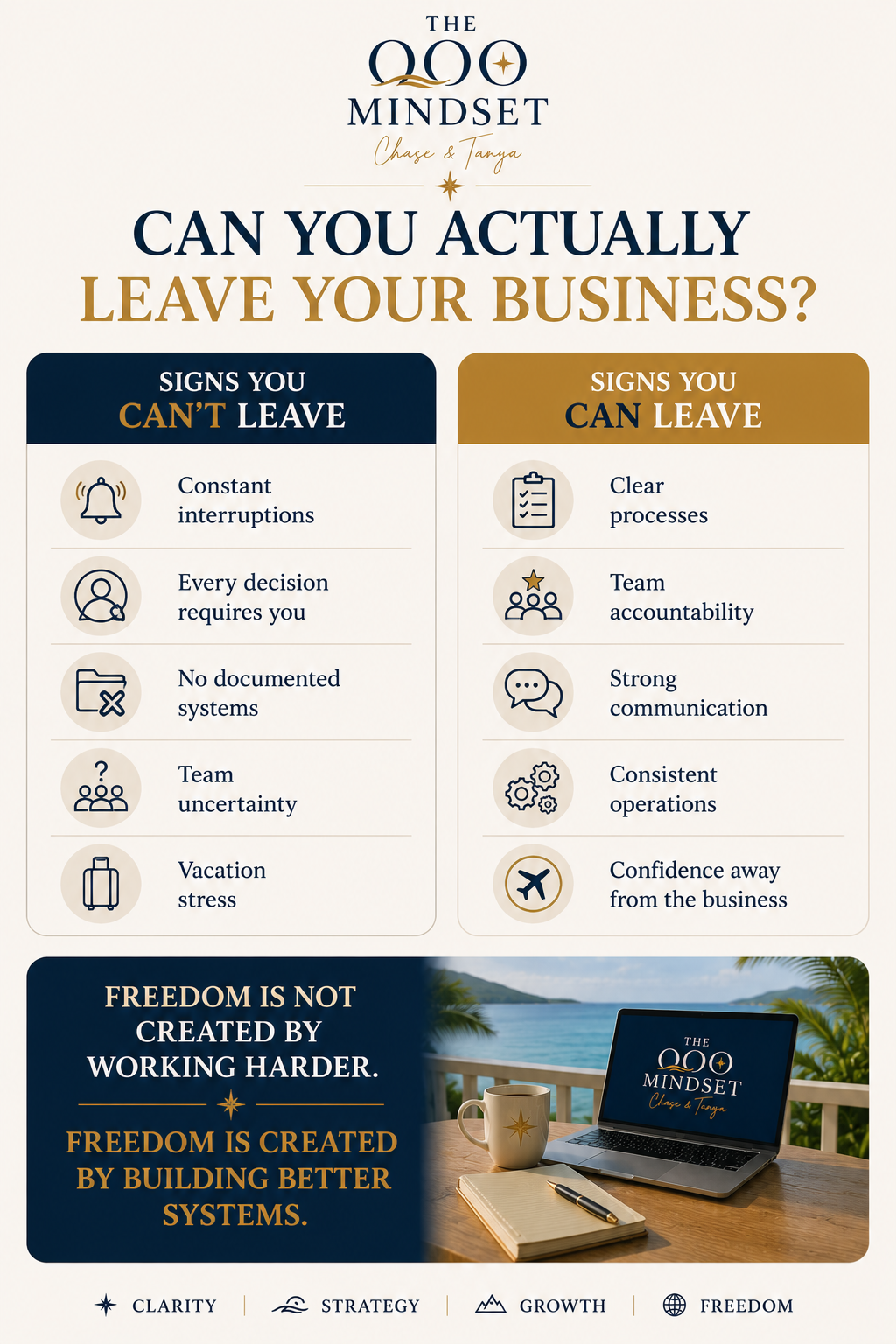
Business Owner Who Can't Leave
Constantly checking messages
Team depends on every decision
Operations stop without them
Burnout increases
Freedom feels impossible
Business Owner Who Can Leave
Clear systems
Strong communication
Team ownership
Consistent operations
Greater flexibility
The Reality Check
Many business owners believe freedom comes after they work harder.
In reality, freedom usually comes after they build better systems.
The businesses that support travel, flexibility, and work-life integration are rarely accidental.
They are intentionally designed.
Location freedom is an operational outcome.
What Happens If You Step Away For A Week?
Could your business continue operating effectively?
Would your team know what to do?
Would your clients still receive a consistent experience?
The answer reveals how dependent your business is on you.
At Out of Office On Purpose, we believe business owners deserve businesses that support their lives—not businesses that require constant supervision.
Freedom is not something you earn someday.
It is something you build intentionally.
